Insights From The Arc: The Intelligent Grid - Energy & Utilities Edition

Why managing AI risk presents new challenges
Aliquet morbi justo auctor cursus auctor aliquam. Neque elit blandit et quis tortor vel ut lectus morbi. Amet mus nunc rhoncus sit sagittis pellentesque eleifend lobortis commodo vestibulum hendrerit proin varius lorem ultrices quam velit sed consequat duis. Lectus condimentum maecenas adipiscing massa neque erat porttitor in adipiscing aliquam auctor aliquam eu phasellus egestas lectus hendrerit sit malesuada tincidunt quisque volutpat aliquet vitae lorem odio feugiat lectus sem purus.
- Lorem ipsum dolor sit amet consectetur lobortis pellentesque sit ullamcorpe.
- Mauris aliquet faucibus iaculis vitae ullamco consectetur praesent luctus.
- Posuere enim mi pharetra neque proin condimentum maecenas adipiscing.
- Posuere enim mi pharetra neque proin nibh dolor amet vitae feugiat.
The difficult of using AI to improve risk management
Viverra mi ut nulla eu mattis in purus. Habitant donec mauris id consectetur. Tempus consequat ornare dui tortor feugiat cursus. Pellentesque massa molestie phasellus enim lobortis pellentesque sit ullamcorper purus. Elementum ante nunc quam pulvinar. Volutpat nibh dolor amet vitae feugiat varius augue justo elit. Vitae amet curabitur in sagittis arcu montes tortor. In enim pulvinar pharetra sagittis fermentum. Ultricies non eu faucibus praesent tristique dolor tellus bibendum. Cursus bibendum nunc enim.

How to bring AI into managing risk
Mattis quisque amet pharetra nisl congue nulla orci. Nibh commodo maecenas adipiscing adipiscing. Blandit ut odio urna arcu quam eleifend donec neque. Augue nisl arcu malesuada interdum risus lectus sed. Pulvinar aliquam morbi arcu commodo. Accumsan elementum elit vitae pellentesque sit. Nibh elementum morbi feugiat amet aliquet. Ultrices duis lobortis mauris nibh pellentesque mattis est maecenas. Tellus pellentesque vivamus massa purus arcu sagittis. Viverra consectetur praesent luctus faucibus phasellus integer fermentum mattis donec.
Pros and cons of using AI to manage risks
Commodo velit viverra neque aliquet tincidunt feugiat. Amet proin cras pharetra mauris leo. In vitae mattis sit fermentum. Maecenas nullam egestas lorem tincidunt eleifend est felis tincidunt. Etiam dictum consectetur blandit tortor vitae. Eget integer tortor in mattis velit ante purus ante.
- Vestibulum faucibus semper vitae imperdiet at eget sed diam ullamcorper vulputate.
- Quam mi proin libero morbi viverra ultrices odio sem felis mattis etiam faucibus morbi.
- Tincidunt ac eu aliquet turpis amet morbi at hendrerit donec pharetra tellus vel nec.
- Sollicitudin egestas sit bibendum malesuada pulvinar sit aliquet turpis lacus ultricies.
“Lacus donec arcu amet diam vestibulum nunc nulla malesuada velit curabitur mauris tempus nunc curabitur dignig pharetra metus consequat.”
Benefits and opportunities for risk managers applying AI
Commodo velit viverra neque aliquet tincidunt feugiat. Amet proin cras pharetra mauris leo. In vitae mattis sit fermentum. Maecenas nullam egestas lorem tincidunt eleifend est felis tincidunt. Etiam dictum consectetur blandit tortor vitae. Eget integer tortor in mattis velit ante purus ante.
Welcome to our sixth edition. The energy and utilities sector stands at a remarkable inflection point, one where decades of infrastructure investment, rapidly escalating demand from artificial intelligence and data centers, and the urgent imperative for AI-driven operational modernization are converging simultaneously. This edition examines the strategies, data innovations, and agentic AI advances reshaping utilities across the nation.
A Grid Under Transformation
The U.S. electric grid is entering what many analysts describe as its most consequential period since electrification itself. After nearly two decades of flat consumption, electricity demand is surging from multiple converging forces: artificial intelligence data centers, industrial onshoring, electric vehicle adoption, and broad building electrification.
According to the U.S. Energy Information Administration’s December 2025 Short-Term Energy Outlook, total U.S. electricity consumption is projected to rise from approximately 4,110 billion kilowatt-hours in 2024 to more than 4,260 billion kilowatt-hours in 2026 marking the first sustained growth in nearly 20 years. (Source: U.S. Energy Information Administration, Short-Term Energy Outlook, December 2025)
In just four years, the five-year forecast for electric power demand growth has increased by a factor of six. If load forecasts are correct, by 2030 new demand will represent over 15% of total national electricity use.
Grid Strategies, National Load Growth Report 2025
Deloitte ’s 2026 Power and Utilities Industry Outlook frames the overarching challenge: utilities must quickly deliver “firm” capacity to stressed parts of the grid while managing customer affordability as retail prices continue to rise. (Source: Deloitte, 2026 Power and Utilities Industry Outlook; Belfer Center for Science and International Affairs, 2025)
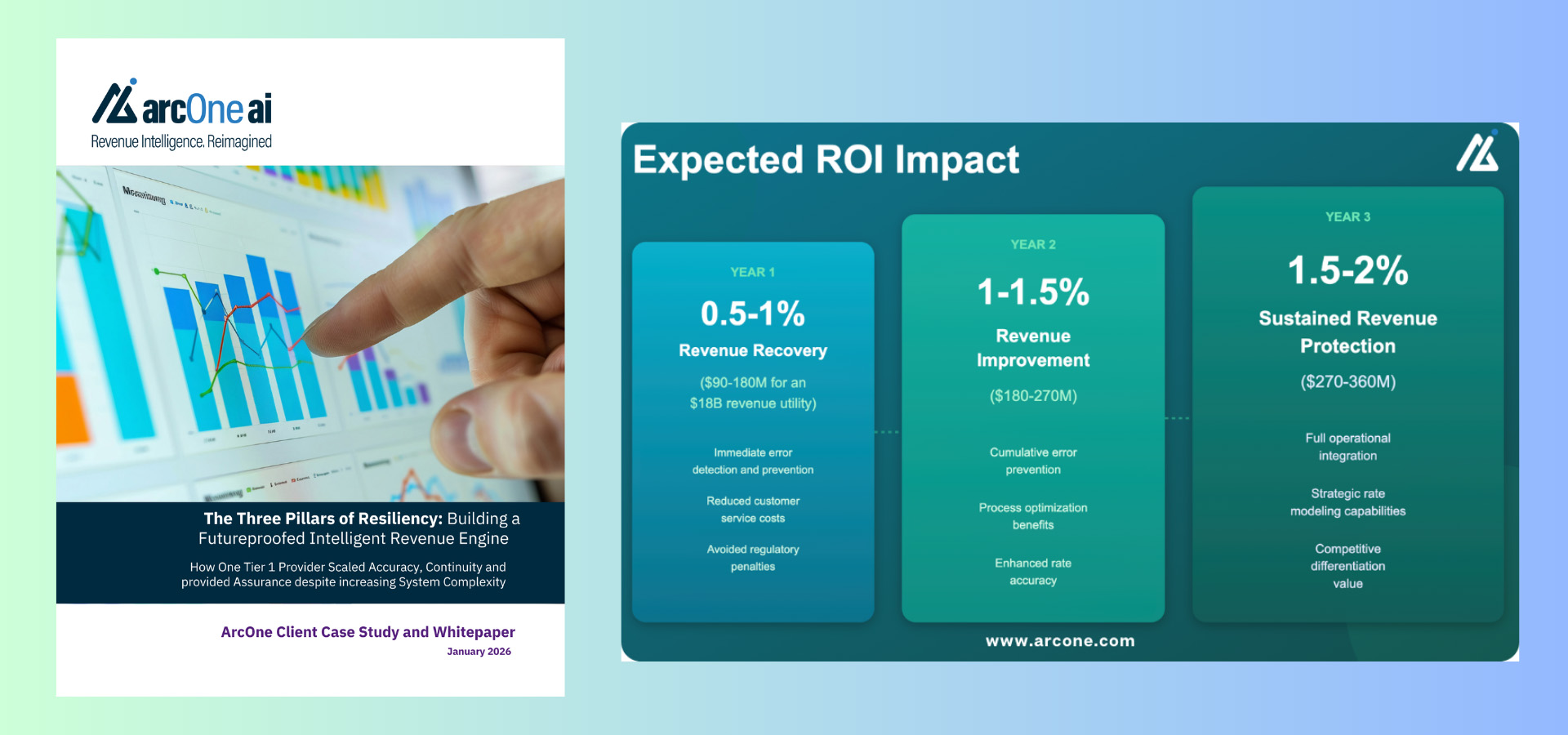
ArcOne AI Case Study: The Three Pillars of Revenue Resiliency
The energy and utilities industry has long accepted 1–3% annual revenue leakage as an unavoidable cost of doing business. For an $18 billion utility, that's up to $540 million walking out the door every year. This is not from a single failure, but from the slow accumulation of billing complexity: time-of-use pricing, distributed generation credits, demand charges, and regulatory fees compounding across millions of transactions. Sampling 1–5% of bills was never going to catch it.
We just published a new case study documenting how a Tier 1 Electric Utility with 6 million customer accounts is tackling this head-on with ArcOne's platform built on three pillars: validating 100% of bills nightly through independent recalculation, maintaining emergency billing operations even during a ransomware attack, and replacing manual exception handling with AI-driven automation.
Early results are already surfacing configuration errors and classification inconsistencies that sampling-based approaches had missed for years.
The projected financial impact is compelling: $90–180M in Year 1, scaling to $270–360M by Year 3.
But beyond the numbers, this case study makes a broader argument that revenue protection in utilities needs to shift from probabilistic to deterministic. The full case study and whitepaper is available to download here.
"The evolution from sampling to certainty, from vulnerability to resilience, and from manual exception handling to intelligent automation represents a fundamental shift in how utilities protect revenue and build operational resilience."
Valli Narayanan, Chief Technology Officer, ArcOne AI
Agentic AI in Energy and Utilities: From Pilots to Production The Shift to Production-Scale Agentic AI
Agentic AI is moving decisively from pilot projects into production at scale across the utility sector. Utilities are preparing for AI-orchestrated grids that manage volatility, distributed energy resources, and outages in real time. However, the path is not without friction.
According to Deloitte’s 2025 Emerging Technology Trends study, while 30% of surveyed organizations are exploring agentic options and 38% are piloting solutions, only 14% have systems ready to deploy and a mere 11% are actively using them in production. (Source: Deloitte, 2025 Emerging Technology Trends Study)
2026: The Year of Data Reckoning
IDC projects that by 2030, fewer than half of energy and utility companies will have mature agent architecture and lifecycle management in place. The fundamental barrier is not the AI technology itself — it is the underlying data infrastructure. Legacy systems and siloed data leave energy and utility companies unable to move forward with AI initiatives until their core IT environments are modernized. (Source: IDC, as cited in BizTech Magazine, December 2025)
Across the energy and utilities sector, the conversation about AI has shifted from “what is possible” to “what is preventing us.” The answer, almost universally, is data. Liz Miller of Constellation Research has articulated the challenge directly: organizations “didn’t get their data in check, didn’t get their legacy systems in check, didn’t clear the table for what AI wants to come and dine on.” (Source: Constellation Research, Inc., as cited in CX Today, December 2025)
For utilities, this data problem is particularly acute. Operational data flows from AMI systems, SCADA, GIS platforms, outage management systems, billing and CRM. Each with its own schema, cadence, and governance. IBM ’s Institute for Business Value notes that utilities must modernize with AI-centric architecture, enable real-time analytics and model training for operational and customer-facing AI, and define robust data governance policies across business units. (Source: IBM, ‘Utilities in the AI Era: Powering Ahead to a Smarter Future,’ November 2025)
Legacy systems and siloed data leave energy and utility companies unable to move forward with AI initiatives until their core IT environments are modernized. They must move away from data silos toward a platform that has an inherent data layer.
Gaia Gallotti Research Director, Energy Insights
IDC; BizTech Magazine, December 2025
The Path to AI-Grade Data Quality
IBM’s utility AI research identifies specific data pipelines that warrant priority investment: transformer loading data, pipeline flow sensors, AMI meter reads, outage event logs, and customer interaction records from CRM. The recommendation is to evaluate and continuously improve these pipelines and not as a separate data quality initiative, but as the core infrastructure on which agentic AI depends. (Source: IBM, ‘Utilities in the AI Era,’ November 2025)
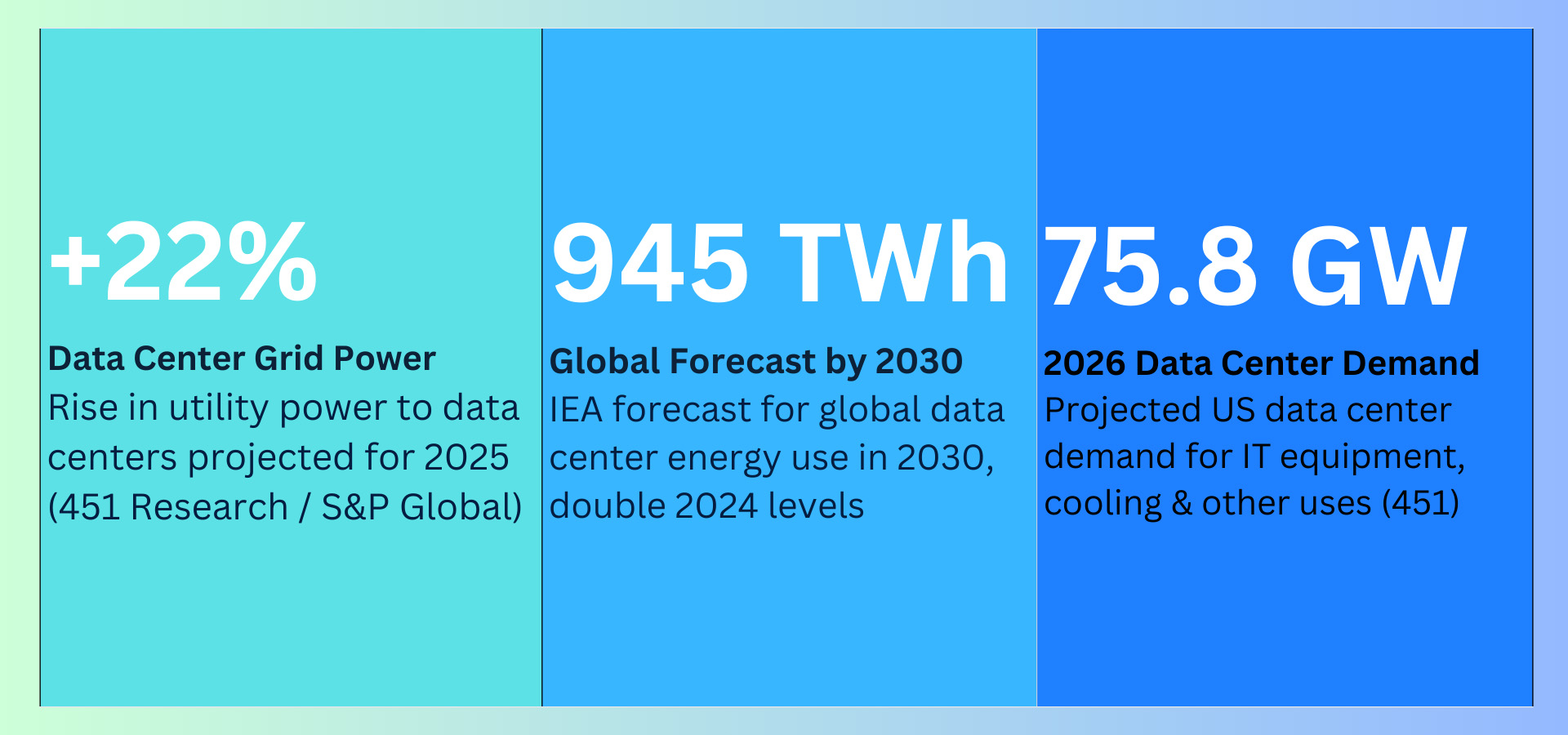
The scale of investment is staggering. The data center buildout race reflects strategic imperatives: companies that fail to build ahead of demand place themselves at a lasting competitive disadvantage. (Source: Belfer Center for Science and International Affairs, ‘AI, Data Centers, and the U.S. Electric Grid: A Watershed Moment,’ 2025)
From Load to Grid Asset: The Co-Development Model
A strategic shift is underway in how utilities and hyperscalers relate to one another. Once viewed as inflexible mega-loads, data centers are now being repositioned as potential operational partners. Deloitte’s 2026 Outlook identifies three ways data centers can support grid reliability: AI-enabled orchestration platforms can shift workloads across regions in real time to align demand with renewable oversupply; advanced power electronics allow data centers to instantly respond to grid fluctuations, functioning like batteries; and flexible load management during peak events can provide measurable relief.
Business Continuity in a Power-Constrained World
For utility leadership, the convergence of rising demand, constrained infrastructure, and escalating regulatory expectations creates a new business continuity calculus.
The 2025 “Rethinking Load Growth” report from the Nicholas Institute for Energy, Environment & Sustainability at Duke University offers an important insight: modeling flexible industrial, transportation, and data center loads suggests the grid could reliably integrate 76–126 GW of new demand with no additional capacity expansion if those loads accepted modest curtailments of just 0.25 to 1% of annual hours. This reframes the challenge from “how do we build enough capacity” to “how do we manage load flexibility as a grid resource.” (Source: Nicholas Institute at Duke University, ‘Rethinking Load Growth,’ 2025; ITIF, November 2025)
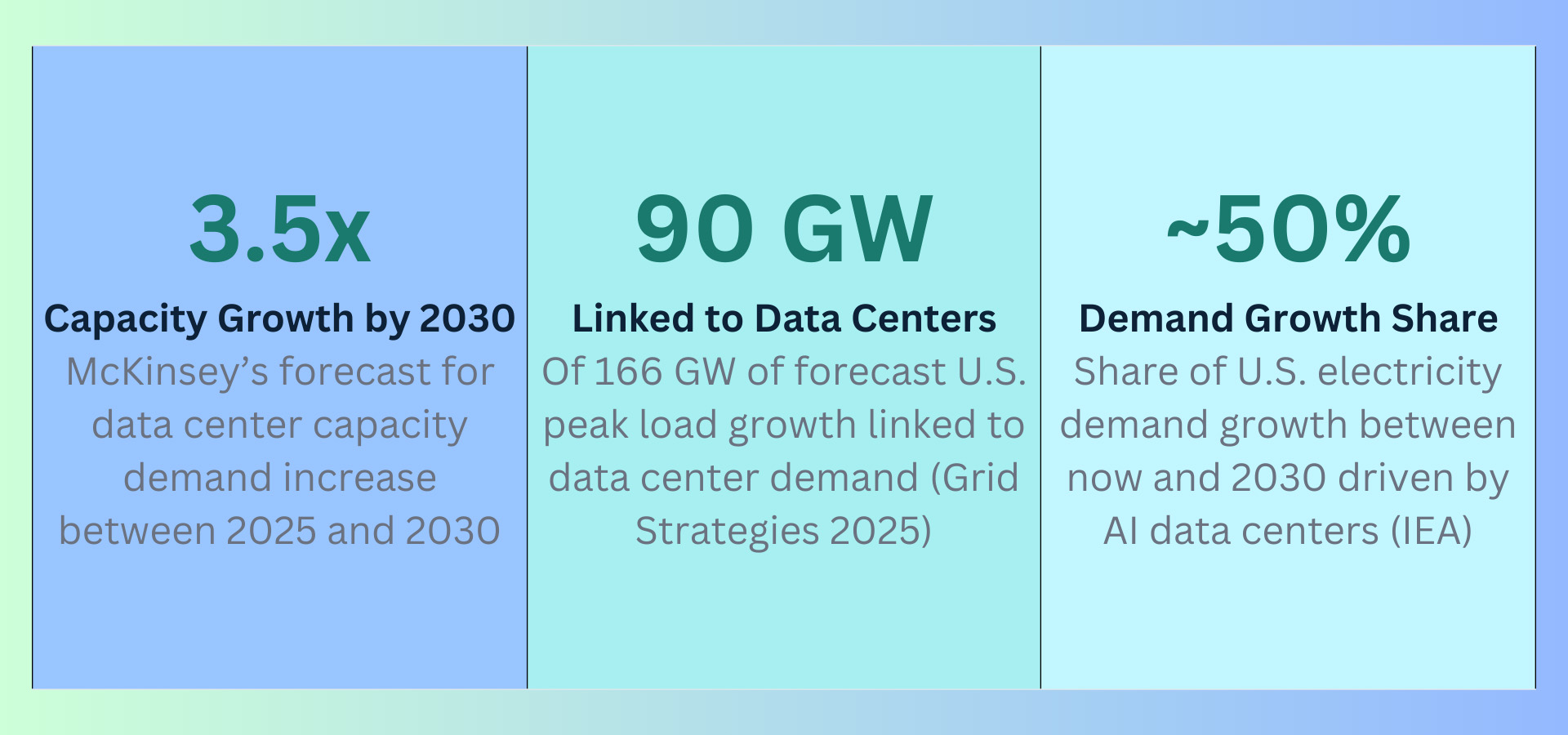
NextEra Energy's experience with agentic AI illustrates the operational benefits of meeting this challenge proactively. By integrating proprietary asset data with advanced AI, NextEra shifted to a predictive model that anticipates equipment issues and optimizes crew deployment against supply chain and weather constraints, reducing costs and improving safety. The company is simultaneously deploying open-source time-series forecasting and weather models to address aging assets and unprecedented load growth, enhancing security-constrained power flow modeling for a more reliable, resilient grid. (Source: Google Cloud Blog, ‘How 7 Power & Energy Companies Are Innovating with Cloud and AI in 2026,’ January 2026)
Over half of utility company executives now expect AI adoption to unlock new technology capabilities that fundamentally transform their business models. The trajectory is clear: adoption levels are expected to surge even for complex applications approaching near-total deployment by 2028 in some operational areas. (Source: IBM, ‘Utilities in the AI Era,’ November 2025)
A Framework for Grid Intelligence
Drawing from industry research and leading utility practice, a three-pillar framework emerges for utilities pursuing AI-enabled operational transformation. As in other sectors undergoing technology-driven convergence, sequential dependencies matter: each pillar enables the next, and skipping steps creates compounding risk.
- Data Infrastructure & IT/OT Modernization: AI-grade data quality, unified AMI/SCADA/CRM pipelines, cloud-edge architecture, cybersecurity posture. Without this foundation, AI initiatives cannot scale.
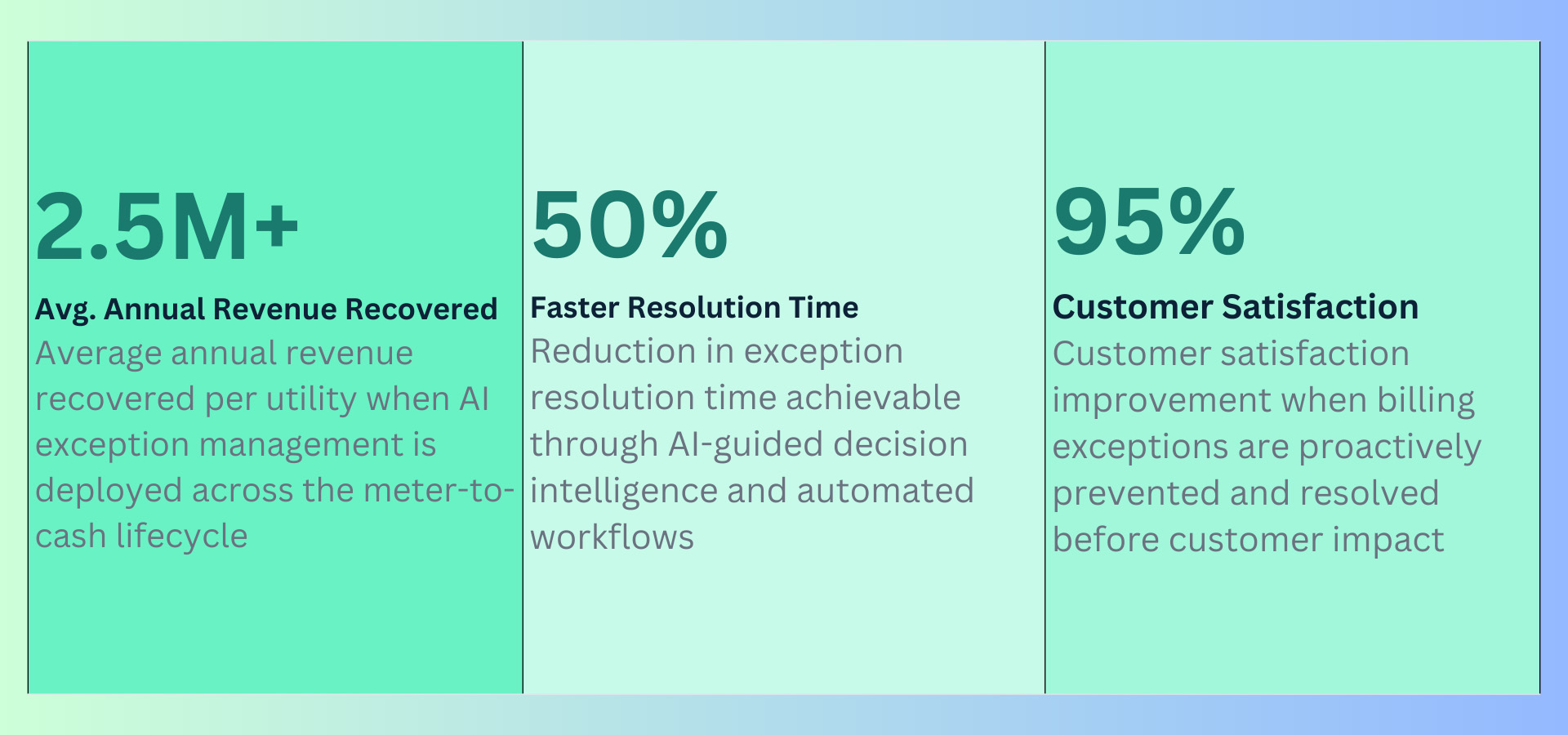
- Agentic AI Deployment & Exception Management: Specialized agents for transformer health, billing exceptions, fraud detection, outage prediction, and demand forecasting. Continuous monitoring replacing reactive dashboards. Read more about ArcOne's Exception360 and some of our client successes.
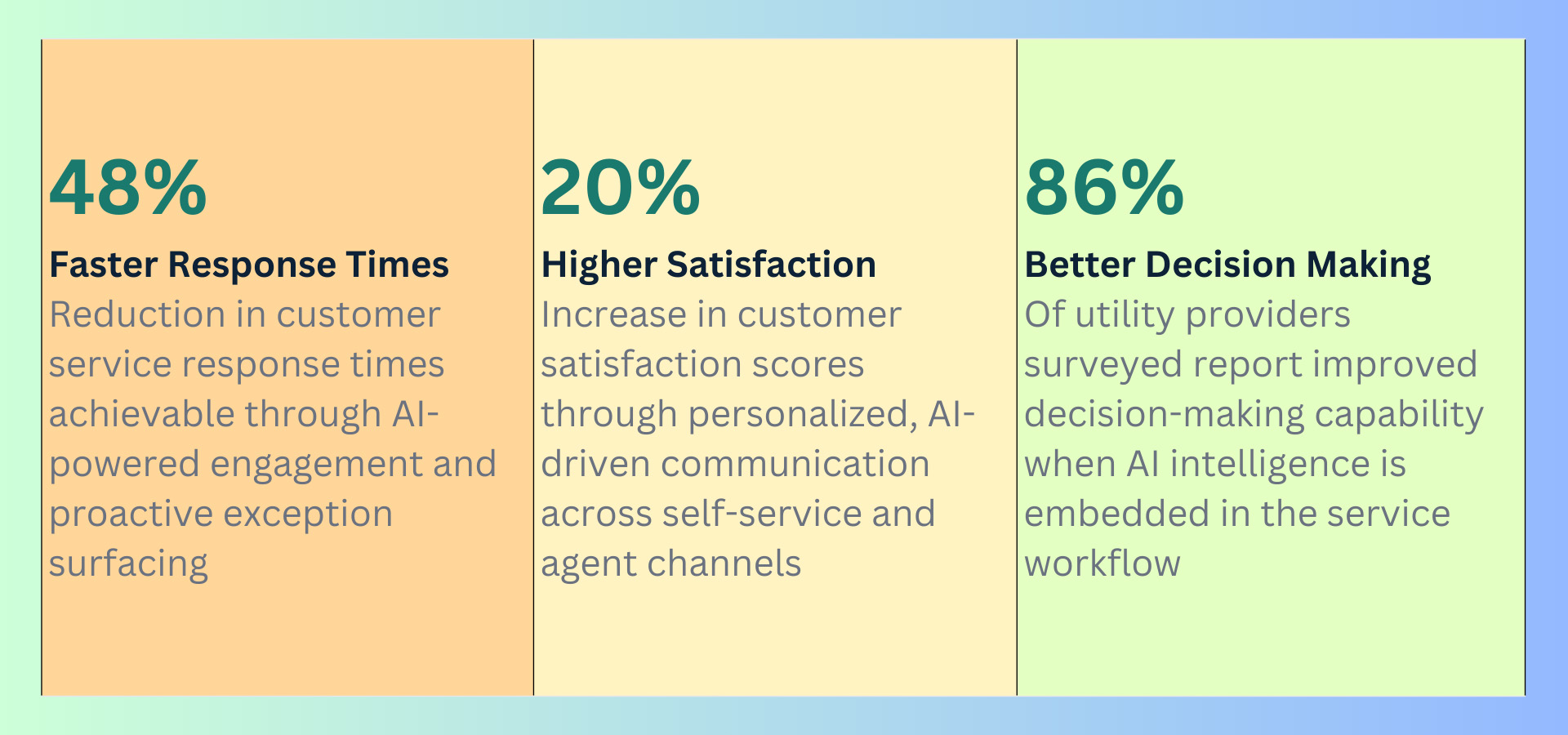
- Customer Intelligence & Grid Asset Optimization: Contextual CX powered by unified customer data, AI-driven outage communication, data center co-development partnerships, and flexible load management as a grid resource. Read more about ArcOne's Experience360 and some of our client successes.
"Experience360 was built with one core principle in mind: put the customer at the center. With a true omni-channel experience and multiple digital touchpoints, we're transforming what used to be a static, transactional bill-pay channel into a dynamic, intelligent, and engaging ecosystem for the utility industry."
John Andersen, VP AI Products and Sales, ArcOne AI
Insights From The Arc Newsletter | Editor: Shaku Selvakumar
We would love to hear from you. Subscribe, like, share, comment or email insights@arcone.com
About ArcOne AI : ArcOne AI helps businesses reimagine revenue management by enhancing profits and reducing operational inefficiencies. We integrate data-driven decision intelligence into enterprise products and financial operations for highly regulated industries such as banking and utilities. Our customers and partners include Fortune 500 companies in banking and utilities. ArcOne AI is headquartered in Austin, Texas with offices in India and a presence through our partners in Europe and ME.