Banking AI Has an Infrastructure Problem. The Vertical AI Orchestration System Is the Fix.

Why managing AI risk presents new challenges
Aliquet morbi justo auctor cursus auctor aliquam. Neque elit blandit et quis tortor vel ut lectus morbi. Amet mus nunc rhoncus sit sagittis pellentesque eleifend lobortis commodo vestibulum hendrerit proin varius lorem ultrices quam velit sed consequat duis. Lectus condimentum maecenas adipiscing massa neque erat porttitor in adipiscing aliquam auctor aliquam eu phasellus egestas lectus hendrerit sit malesuada tincidunt quisque volutpat aliquet vitae lorem odio feugiat lectus sem purus.
- Lorem ipsum dolor sit amet consectetur lobortis pellentesque sit ullamcorpe.
- Mauris aliquet faucibus iaculis vitae ullamco consectetur praesent luctus.
- Posuere enim mi pharetra neque proin condimentum maecenas adipiscing.
- Posuere enim mi pharetra neque proin nibh dolor amet vitae feugiat.
The difficult of using AI to improve risk management
Viverra mi ut nulla eu mattis in purus. Habitant donec mauris id consectetur. Tempus consequat ornare dui tortor feugiat cursus. Pellentesque massa molestie phasellus enim lobortis pellentesque sit ullamcorper purus. Elementum ante nunc quam pulvinar. Volutpat nibh dolor amet vitae feugiat varius augue justo elit. Vitae amet curabitur in sagittis arcu montes tortor. In enim pulvinar pharetra sagittis fermentum. Ultricies non eu faucibus praesent tristique dolor tellus bibendum. Cursus bibendum nunc enim.

How to bring AI into managing risk
Mattis quisque amet pharetra nisl congue nulla orci. Nibh commodo maecenas adipiscing adipiscing. Blandit ut odio urna arcu quam eleifend donec neque. Augue nisl arcu malesuada interdum risus lectus sed. Pulvinar aliquam morbi arcu commodo. Accumsan elementum elit vitae pellentesque sit. Nibh elementum morbi feugiat amet aliquet. Ultrices duis lobortis mauris nibh pellentesque mattis est maecenas. Tellus pellentesque vivamus massa purus arcu sagittis. Viverra consectetur praesent luctus faucibus phasellus integer fermentum mattis donec.
Pros and cons of using AI to manage risks
Commodo velit viverra neque aliquet tincidunt feugiat. Amet proin cras pharetra mauris leo. In vitae mattis sit fermentum. Maecenas nullam egestas lorem tincidunt eleifend est felis tincidunt. Etiam dictum consectetur blandit tortor vitae. Eget integer tortor in mattis velit ante purus ante.
- Vestibulum faucibus semper vitae imperdiet at eget sed diam ullamcorper vulputate.
- Quam mi proin libero morbi viverra ultrices odio sem felis mattis etiam faucibus morbi.
- Tincidunt ac eu aliquet turpis amet morbi at hendrerit donec pharetra tellus vel nec.
- Sollicitudin egestas sit bibendum malesuada pulvinar sit aliquet turpis lacus ultricies.
“Lacus donec arcu amet diam vestibulum nunc nulla malesuada velit curabitur mauris tempus nunc curabitur dignig pharetra metus consequat.”
Benefits and opportunities for risk managers applying AI
Commodo velit viverra neque aliquet tincidunt feugiat. Amet proin cras pharetra mauris leo. In vitae mattis sit fermentum. Maecenas nullam egestas lorem tincidunt eleifend est felis tincidunt. Etiam dictum consectetur blandit tortor vitae. Eget integer tortor in mattis velit ante purus ante.
Banking AI Has an Infrastructure Problem. The Vertical AI Orchestration System Is the Fix.
From fragmented cores, siloed data, and a lack of meaningful governance guardrails that takes months of engineering work to untangle before a single model can run reliably. A large bank operating ten or fifteen core systems simultaneously isn't an edge case; it's the norm. And every AI deployment that sits on top of that environment inherits every problem within it.
That's the gap we set out to close. Today, with the launch of ArcOne BankOS™™, I believe we have.
The Real Reason Banking AI Stalls
The narrative around AI in banking is focused heavily on models- previously machine learning models, and now language models- which ones to use, how to fine-tune them, how to evaluate them. That's the wrong conversation to be having first.
AI agents require clean, governed, semantically consistent data to function reliably. Not eventually, but from day one. An agent that can't trust the data it's operating on will hallucinate, misfire, or produce outputs that no risk committee will sign off on, and in a regulated environment, that's where the deployment dies.
The industry has invested an estimated $35 billion in banking AI and is on track to nearly triple that. Most of it has produced pilots. The reason isn't that the technology isn't ready, BUT it's that the infrastructure it needs to run on isn't ready.
What an Intelligent Vertical Orchestration System Actually Does
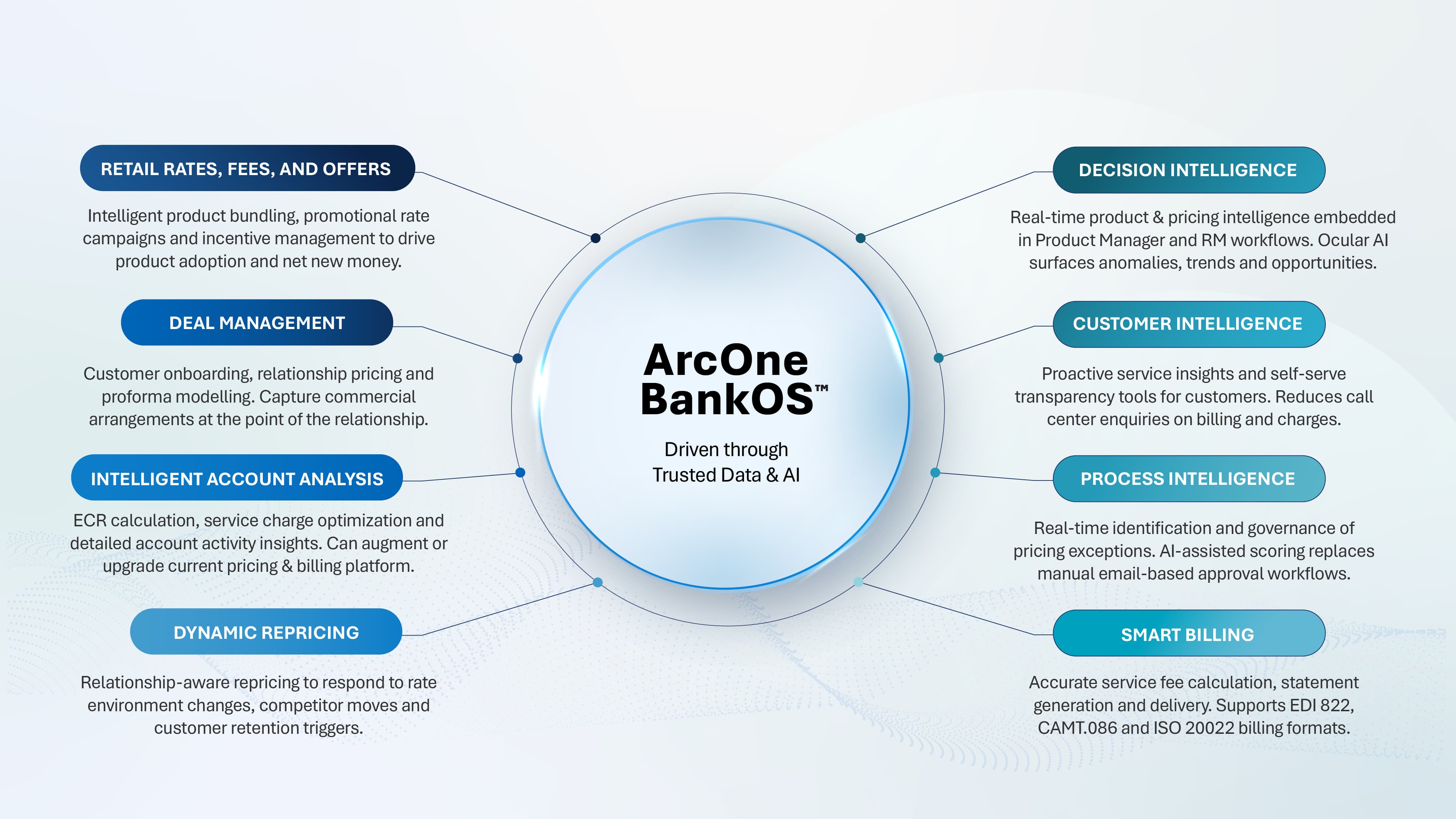
When we talk about ArcOne BankOS™™ as an operating system for banking, we mean something specific. It is not a metaphor. An actual infrastructure layer that sits between the complexity of existing banking environments and the intelligence you want to deploy on top of them.
It's built a proven Data & AI platform called Ocular AI and its three integrated fabrics, each solving a distinct part of the problem.
Think about what actually slows down every banking AI project before it even starts. Someone has to figure out where the data lives, what it means, and how to make it consistent across systems that were never designed to talk to each other. We solved that first.
The Data Fabric handles the mapping problem automatically. Our Banking Domain Cartridge connects to 60+ enterprise systems and auto-maps more than 80% of fields across every major banking core into a unified semantic layer, pre-loaded with Commercial, Retail, and Global Transaction Banking terminology. Work that used to consume a data engineering team for months now takes days. That is the foundation everything else runs on.
The Intelligence Fabric is where we diverged from what everyone else is building. Most platforms give you a model. We built a factory: a system that identifies, trains, deploys, governs, and monitors both ML and language models, then configures them into AI agents that can actually work in a regulated environment. TERRA, our orchestration engine, coordinates 100+ agents across Retail, Commercial, Global Transaction Banking, Wealth Management, and Retirement. The agents don't operate in isolation. They coordinate.
The Agent Fabric is where that coordination becomes revenue. Enrich360 handles pricing, product, and profit intelligence. Experience360 covers customer engagement. Exceptions360 manages process and exception automation. LYZA, our multi-modal interface, lets banking professionals access the entire agent ecosystem through voice, text, video, or documents. This is not a prototype environment. These are production applications running on top of your existing infrastructure, with nothing ripped out and replaced.
What makes this different from assembling three separate tools is that these fabrics share a common foundation. Governance, audit lineage, and explainability are properties of the stack, not add-ons bolted onto individual products. When a new agent goes live, it inherits all of that automatically.

Why Vertical Orchestration Is the Only Architecture That Works
Point solutions delivered through AI Agents don't solve infrastructure problems. They add to them.
A bank that deploys a pricing AI Agent here, a customer intelligence tool there, and an exceptions workflow somewhere else hasn't built an intelligent bank. It's built a more complicated one. Each solution has its own data model, its own governance requirements, its own integration surface. The overhead compounds. And when a regulator asks how a decision was made across that environment, the answer is usually: we're not entirely sure.
A unified architecture changes the fundamental equation. When the data fabric, the intelligence fabric, and the agent fabric share a common foundation, every workflow deployed inherits the same governed data layer, the same audit trail, the same lineage tracking. Governance isn't something you bolt on. It's a property of the platform itself.
ArcOne BankOS™ is built to ISO 42001 Responsible AI standards. Audit-ready lineage and explainability are architectural properties, not features. When a new agent goes live, it comes with the full governance stack already in place.
What This Makes Possible for Banking
We're already in production across institutions that between them represent the full spectrum of banking complexity.
What these deployments have in common: they went from contract to production in four to six months. No large data engineering team. No disruption to existing operations. No multi-year transformation cycle before the first result.
That deployment model is not an accident of favorable conditions. It's a design requirement we held ourselves to. The infrastructure gap in banking has persisted partly because the solutions proposed to fix it were themselves too complex and too slow to deploy. We built ArcOne BankOS™ to be the exception to that pattern.
The Moment We've Been Building Toward
Launching ArcOne BankOS™ is the moment where the work we have done across years of building revenue intelligence for Fortune 500 banks crystallizes into something larger. ArcOne EPM and IntelliArc products gave us the ground truth: the real operational complexity of banking data environments, the real requirements of risk committees, the real pace at which institutions can absorb change. Those years also gave us the relationships that matter, with active Fortune 500 client engagements and vertical partnerships with FIS, DXC, IBM, Deloitte, Fiserv and others who understand what it takes to deploy in this industry.
ArcOne BankOS™ is what we built when we took all of that and asked: what would it take to make every bank AI-ready? Not in theory. In production. Without replacing what they've already built.
The answer is an AI Orchestration System. A governed semantic layer built for banking. An orchestrated agent workforce that understands the domain. And applications that generate measurable results, not another proof of concept that stalls before it scales.
That is what we have built, and I believe vertical orchestration is the missing layer the banking industry has needed for a long time.
ArcOne BankOS™ is generally available now. To learn more or schedule a demonstration, visit arcone.com.
ArcOne BankOS™, Ocular AI™, LYZA™, TERRA™, IntelliArc™, Enrich360™, Experience360™, and Exceptions360™ are trademarks of ArcOne AI.